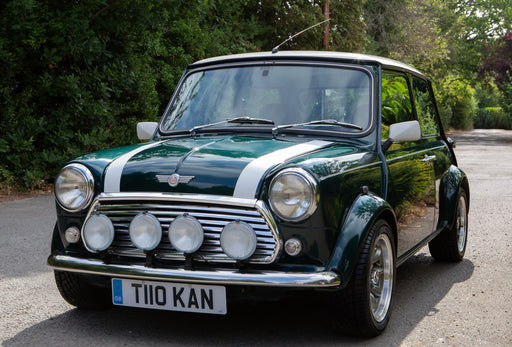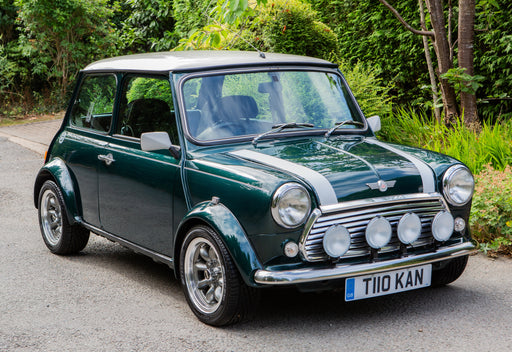
Sell your classic car

At least once a week, we get asked the same question: “How can I tell what Mark a Classic Mini is?” And it’s a fair question, because the car kept the same iconic shape for 41 years, so the differences between a 1960 saloon and a 1999 Cooper often come down to details.
In this guide, we explain the differences. Many clues are visible on the outside of the car, and if you learn to spot a few, you’ll quickly be able to place most Classic Minis by decade. As always, this comes with a caveat: ultimately, it comes down to the paperwork.
The earliest Minis, built between 1959 and 1967, can be recognised by sliding front windows, hinges mounted on the outside of the doors and a front grille with a ‘whiskered’ look to it. Early cars were produced through both BMC sides of the Mini story: the Austin version at Longbridge and the Morris Mini-Minor at Cowley.
Over the next four decades, the Mini kept changing. By the time production ended in 2000, later versions had gained features including fuel injection, a catalytic converter and an airbag. There were tremendous variations in performance and desirability, even though the fundamental shape remained instantly recognisable.
The standard Mini saloon developed from the Mk1 into the Mk2 and then the Mk3. The Clubman, introduced in 1969, should be thought of separately: it was a restyled Mini model with a distinctive longer, squarer front end and was sold alongside the traditional shape.
Another reason identification can become confusing is that engines, trim and body parts have often been changed during a Mini’s life. The original Cooper S was produced in several versions during the 1960s and into the early 1970s, while the Cooper name returned later in the Mini’s life. A 1275cc engine on its own therefore doesn’t prove that a car is a particular Cooper or Cooper S.
Here are some quick ‘tells’ that will give you an idea about the model of Mini you’re looking at:
We have a full guide about the difference between Mk1, Mk2, Mk3 and Mk4 if you’d like to know more.
The mechanical and cosmetic changes kept coming:
Sportspack styling is another useful late-model clue. Factory Sportspack cars are associated with wide wheel arches and 13-inch wheels, although these parts have also been fitted retrospectively to many Minis.
Rover leaned heavily on limited editions in the final decades of production, using colours, trim and equipment to give different versions of the Mini their own character.
Special editions included:
The Paul Smith edition arrived in 1998, with 1,800 produced worldwide and 300 allocated to the UK market. UK examples were finished in distinctive Paul Smith Blue with details including charcoal-grey 12-inch Minilite-style wheels, twin spot lamps, black leather trim and Paul Smith badging. More unusual details included flashes of citrus green inside areas such as the glovebox and boot.

The Italian Job, Rio, Mini Thirty and other editions likewise had distinctive combinations of paint, decals, trim and wheels.

However, wheels, badges, mirrors and other cosmetic details are relatively easy to change, so they should be treated as clues rather than proof of a car’s original specification.
Because the Mini shell and running gear share so many components across the range, engines, gearboxes, trim and other parts can be moved from one car to another.
Owners have also converted cars to resemble earlier or more desirable models. A grille, set of arches, badge or even some body details may therefore have been fitted years after the car left the factory.
Visual clues are extremely useful for narrowing down the period or model you may be looking at, but confirming exactly what a car is requires its identifying numbers and supporting history.
Mk2 versus early Mk3: these are the closest visual match in the whole range; a reliable tell is that the door hinges on the Mk2 are outside, but they are hidden on a Mk3.
Mini Cooper Sport and the Mini Cooper Sportspack: many people miss this, but it’s worth noting that the Mini Cooper Sport and the Mini Cooper Sportspack are different. The former was a standalone model, while the latter was an optional extra on Mk7 Minis.
Early-90s SPi Cooper versus late-90s MPi Cooper: from a distance they can look the same, but under the bonnet they are set up differently – an MPi has the radiator mounted at the front of the engine, while an SPi’s sits to the side.
Before trusting appearances, it’s worth checking:
Heritage records do not survive for every Classic Mini, so the availability and level of detail of a Heritage Certificate depends on the factory records held for that particular model and period.
Yes, this isn’t as exciting as spotting a Sportspack arch or a special-edition colour, but paperwork is what helps turn visual clues into a properly supported identification.
If you’re inspired to join the Classic Mini owners’ club, you can view our collection of Classic Minis and read our guide to the best Classic Mini to buy. If you’re thinking of selling a Classic Mini, we’d love to help you pass on your cherished Classic Mini to a new owner. Please get in touch if you have any questions.
The Mini John Cooper LE 40 was unveiled in 1999, celebrating 40 remarkable years of the Mini and honouring the Cooper’s triumph in the F1 World Cha...
View detailsThis Mini Cooper Sportspack was first registered by Bristol Minis on 8th August 2000 and is presented in rare Nightfire Red with a white roof and b...
View detailsThis Mini Cooper Sportspack was first registered on 22nd February 1999 and is presented in Anthracite grey with a white roof and body decals, over ...
View detailsThis Mini Cooper Sportspack was originally supplied by Evans Halshaw Rover on 31st March 2000 and is presented in rare Anthracite grey with a white...
View detailsWe are delighted to present this stunning Mini Cooper Sport, originally supplied by Thomas Day Motors, Fleet on 30th June 2000. The Mini is finishe...
View detailsThis Mini Cooper Sportspack was originally supplied by Whichford Rover, Basingstoke on 1st March 1999 and is presented in iconic British Racing Gre...
View details